Showing posts with label fantasy rpg. Show all posts

Wednesday, 4 March 2026

Waterdeep : Dragon Heist

After the fast-paced excitement of Hope's Last Day, we slowed things down a little and returned to D&D 5e. We did not play in our usual Saltmarsh campaign, but went back to 2nd level to start a new campaign in Waterdeep. Again, we were six players and a DM until around half-way through when a couple of the players had to head off home.

Characters - I will update as and when I can...

G : Wizard - (left early)
J : Fighter - (left early)
Erlathan Sylmaer (Ranger)
Rexius Trannyth (Bard)
Zorrion Oakwood (Rogue)
Theratis Wyrmsbane (Cleric)


The new campaign module - Waterdeep

We had been travelling through the Troll Swamps for several days, cold, tired, hungry and in need of a good rest, when lights were spotted in the distance. We had, at last, arrived at our destination - the town of Waterdeep.

The first tavern we came to was the Yawning portal, where we grabbed a table and some well-deserved food and ale. Whilst enquiring about the massive hole in the middle of the floor, which was rumoured to be an entrance to the underworld, or maybe just the sewers depending upon you outlook, a bar-room brawl broke out. The well-oiled machine of the City Watch came in, crashed a few heads together, and carted off the guilty parties. As we enquired about getting work, the barkeep pointed us in the direction of a fellow named Volo, a writer and purveyor of books about monsters, at the far end of the bar, but before we could get there, a troll and a flock of stirges emerged from the aforementioned deep hole.

The barkeep kept the troll at bay whilst we eliminated the stirges and then we returned to help with the troll, but the majority of the tavern's patrons had left quickly by the door. Volo, the only other person who did not leave the tavern, noticed our competence and offered us a job as we looked like we could handle ourselves in a tight pinch. We were to track down a chap named Flum Blagma, who was kidnapped a few nights ago.

Our enquiries took us to a variety of places and we were able to pick up a few clues; Flum was with the younger Lord Neverember on the night of his disappearance, both were dressed the same, Neverember left the tavern before Flum, both were followed by people in black robes as they left the establishment, Flum was accosted by the Xantharum crew. At one point during our investigations, we noticed three ruffians watching us. We followed them only to come across the results of an alleyway skirmish, but we were ushered away by the Watch.

At the docks we gathered a few more clues; the Xantharum crew marked their properties with a yellow chalked eye symbol. Looking around we found an old warehouse that bore that symbol. Opposite the warehouse was a little curiosity shoppe, where we managed to get more details of the kidnapping after purchasing a few trinkets from the proprietor. So, we recrossed the street and entered the premises, the gate was unlocked after all, to look around.

Our rogue picked the lock on the main door and we slid inside only to find the main warehouse room to be full of boxes, crates, and a dozen dead Xantharum cultists. From the bodies we managed to procure a few weapons and a bag of silver coins, but we were interrupted by three small creatures (Kenku). The bird-like kidnappers yelled out that there was nothing to fear, but our wizard responded to their obvious ruse by yelling back that of course we had nothing to fear from budgie smugglers. The melee was short and bloody.

The budgie smugglers (Kenku)

A search of the rooms in the upper storey of the premises didn't reveal much except a paper origami bird, a pouch of gold coins, thousands of shipping rosters and a couple of alarm bells (we snipped their chords).

We returned downstairs to investigate the only room left - the one under the stairs. The small room was full of linen and rugs etc. under which we found Renier Neverember. The Xantharum cultists had taken him instead of Flum due to a case of mistaken identity. As a reward, he gave us a key that didn't fit any of the rooms in the warehouse, but we pocketed it anyway. At this point, the ever vigilant City Watch had been called and had filed into the warehouse to investigate what was going on. We explained all that had happened and the leader upon hearing that we wanted to find Flum gave us directions to a sewer entrance and a bag of Healing potions - he said that we would need them.

We entered the sewer system via a marked entrance in Shark Street. We splashed along a corridor and stopped at a junction with a large column that supported the roof and a couple of arrow slits. To the north-west was a ledge with a stone door.

We managed to duck under the arrow slits and get to the door without being shot full of arrows and bolts, and found that the key that Renier Neverember gave us turned the lock.

After passing through an obvious armoury we arrived at one of the rooms that held an arrow slit overlooking the sewer outside. The sleeping goblin that was supposed to be on guard was quietly dispatched. Moving along further we came to a small barracks room with another sleeping guard. He too was quietly dealt with, as was the grey ooze that had previously taken a couple of goblins for supper.

The final room was fairly long with a raised dais at the end. In the centre of the room, an orc was torturing Flum whilst being watched by what appeared to be a Mind Flayer and an Intellect Devourer. We froze in horror knowing how powerful such beings were, but after a few moments the Mind Flayer left the room via a wall covering/curtain.

The sewers of Waterdeep

The sewers of Waterdeep from a different perspective

The melee was brief, with the end result being that the orc was defeated and the Intellect Devourer was stamped under foot by the ranger. Flum was untied and rescued. A quick look around the room revealed a small chest behind the throne on the dais that contained a number of coins and a few potions of Healing. Behind the curtain was revealed a room with a hovering sphere with ten rays radiating from it. We just noticed that the Mind Flayer from the previous room had just fiddled with a stone and disappeared into a void that the process opened. We did not follow.

We returned to the Yawning Portal tavern and handed Flum over to Volo. Volo skirted the issue of our payment until we demanded it of him, but all he could promise was a run-down three-storey building in Troll Skull Alley. We were not happy but accepted it none-the-less, but were pleased when the notary sorting out the deal mentioned that when done up it could be worth a lot more than the gold we were offered for the job.

The following day we paid a visit on Lord Neverember to check in on Renier who we rescued, but no reward was forthcoming. The City Watch also only passed a few coins our way and thanked us for our diligent work as we told them about the sewer complex and what we had seen.

At this point two of our players had to leave.

Over the next few weeks we began to renovate our new house and discovered that the origami bird was a magical device where we could write a message on it, say the recipients name and it would deliver the message to them and return once read.

One day we got a knock at the door from the City Watch requesting that we attend the High Magistrate immediately. Upon arrival we are ushered into the High Magistrate's presence to be told that one of the other magistrates has been turned in to a rat and she was needed back urgently. We would need to head to the graveyard to recover a staff that could accomplish this.

We left straight away, the lure of 500 gold crowns being quite the enticer, and eventually found the Lord Greyforce mausoleum in the out of town graveyard. We opened the iron gated entrance and entered the tomb to discover a number of urns and a large stone coffin dedicated to the great wizard Nashblack. We slid the top off the coffin aside and climbed down the spiral staircase within.

At the bottom of the staircase was a large room, in the centre of which was a pedestal with the letters N, E, S and W written on raised disks at the appropriate cardinal points. Our rogue pressed down onto the S disk and was immediately transported off somewhere. Not wanting to be left behind, we all followed suit despite not knowing whether he had just been disintegrated for his troubles.

We ended up in a dark room with a large stone statue holding a sword and shield. This came to life as we approached it and we had to fight for our lives to overcome the guardian. We eventually defeated it and it crumbled to dust revealing a disc with a zig-zag design on it, which we picked up. Two doors were also revealed upon the guardian's defeat.

We exited the northern door only to find ourselves in a similar situation, only there were two statues this time. Again we fought the guardians and caused them to crumble revealing another graven disk and two more doors.

As we were now very badly battered and in need of recovery, we took a long rest and decided to carry on once we had recovered our strength.

After our rest we went through the north door of this chamber as the south door didn't open. The next room revealed another stone statue, as did a fourth room - an encounter with a stone Beholder. We now had four discs with varying symbols on them and knew how the chambers and doors worked.

Within the tomb

After we exited the fourth room with the Beholder statue we ended up back in the first chamber with the N, E, S, W pedestal. We deduced that the discs we had picked up in the other rooms would need to be placed upon the pedestal in the correct order. We gathered they were relevant to each direction and guessed first time - the pedestal began to grate its way open to reveal another descending spiral staircase.

The chamber at the bottom of this staircase was almost identical to the one above except the symbols on its pedestal were linked to the elements, and there were four mirrors in the room; one at each cardinal point.

As we had the gist of what was going on by now, we looked into the first mirror and got transported to a small room containing an air elemental. We fought this being, and like before, when it was defeated, a small white/grey disc appeared on the floor and a mirror appeared on the north wall. We headed on straight through the mirror and encountered an earth elemental. This fight took most of our strength so we took another long rest before continuing onwards with our newly found green/brown disc.

After our recuperation we stepped to the next mirror only to find that the room beyond contained a small earth elemental. We fought this being but got no disc for our troubles. A quick think resulted in us working out what had happened; the rooms had all begun to regenerate their defeated occupants and  had moved round ninety degrees. We fought our way through the last of the elemental rooms to collect the rest of the four discs and got transported back to the first mirrored room with the pedestal. 

Again, we put the discs onto the pedestal in the correct order and the plinth opened to reveal a golden staff. We picked up the staff, wedged open the pedestal just in case and climbed the staircase out of there. We then passed through the upper chamber and emerged back into the crypt.

Pleased with ourselves, we left the crypt in a joyful mood, only to bump into a bent-over wizard with a rat in a cage. The old man, who was familiar to us from somewhere, asked us for the sceptre so that he could change the rat back to a person again. We naively handed over the sceptre and the old wizard duly slammed it onto the ground and released the rat from the cage. The rat turned into a dark-haired male individual, not a female as we were told, and snapped the neck of the wizened man. He then demanded our subservience and, to our shame, we all cowered in fear except for our Ranger who fought the charlatan. We each eventually overcame our fear and joined the melee, and finally defeated the black-haired man by weight of numbers. We reclaimed the staff and two potions of Healing, a pouch of coins and two small candles from the old man's knapsack. After hiding the bodies, we headed back into town to see the High Magistrate.

It turned out that the real High Magistrate, the woman who had supposedly been turned into a rat, had been out of town for a short period of time and that we had been hoodwinked into getting the staff. The old fellow was her scribe but she was unaware who the other man was. She asked us to return the staff to where it came from and that as a reward we could keep anything we found in the scribe's house. This turned out to be a rather splendid magical short sword, a magical quill and ink well and a gold ring with an emerald in it. There was also a ledger detailing more about the family Nashblack.

Monday, 2 March 2026

Gaming Weekend 2 - Alien and D&D 5e

This weekend just gone, I was invited for a second weekender gaming session with my fellow D&D Thursday Nighters. This time round we got to play a couple of different games away from the ongoing Saltmarsh campaign. First off, we immersed ourselves into the sci-fi genre with an Alien RPG/boardgame, before returning to the fantasy realms with the first section of another D&D 5e adventure; but this time with some pre-generated characters.

For both games we had a GM and six players, although towards the end of the D&D adventure we lost two of the players and had to continue on without them. Unfortunately, I was unable to get a list of the character names, so I will have to refer to them either by their class or player's initial in this summary write-up. Hopefully, the DM can supply me with a list of the characters in each game and I will be able to add them to the after action reports on these soon; right after the write-up of last Thursday's Saltmarsh outing.

The Alien RPG/boardgame was called something like Hope's Last Day, and it involved a bunch of terra-formers trying to make sense of what happened to their home base when they returned from an aborted mission to the out. They returned to Hadley's Hope a few days before the colonial marines arrived on the scene; they are the last survivors (other than those in the Aliens film), and this is their last few hours. We each played a character that had their own agenda for the final few hours of the colony's existence.

Hadley's Hope LV-426 is the scene for this RPG/boardgame

The Alien game's characters were all pre-generated handouts:

G : Science Officer
J : ?
K : Chief mechanic
M : Samuel Sung (Mechanic)
R : Base team leader
W : ?

The D&D adventure was the first part of the Waterdeep : Dragon Heist campaign. Our characters were all 2nd level for this game. If we take this forward, we will most likely rename, or at least amend, the names of our characters.

Waterdeep - a new D&D 5e campaign

The D&D game's characters were also pre-generated:

G : Wizard - (had to leave early)
J : Fighter - (had to leave early)
K : Ranger
M : Rexius Trannyth (Bard)
R : Zorrion Oakwood (Rogue)
W : Cleric

Next up should be the latest Saltmarsh campaign session, followed by write-ups of the Alien and Waterdeep adventures.

Monday, 13 October 2025

RPGs or Tabletop Battle Games?

I was lucky to be the right age when D&D first came to the UK in the mid-late 1970s. A couple of school friends introduced me to the game (Basic D&D - the Blue books), but also many gaming clubs formed in local church halls etc. at around the same time. These venues allowed like-minded teenagers to get together and play in the realms of our imaginations with the plethora of Role Playing Games (RPGs) that then came out at that time.

It was with my school friends and at local clubs (where I met some very dear friends) where I played a huge variety of those RPGs; mainly D&D, Runequest and Traveller. I tried others, but these were the main three I stuck with.

Advanced Dungeons and Dragons

So, although I generally played in games classed as RPGs, where most of the action took place in what is now termed "Theatre of the Mind", occasionally with a handful of miniatures thrown down on a hand drawn map, I became aware of others playing what were termed "wargames", where dozens or even hundreds of miniatures were laid out on what were to me as realistic a table as could be made at the time.

I have played many iterations of wargames over the last few decades, from small skirmish level games (5-10 figures on a table) up to battalion level wargames that involved several hundreds of miniatures. I was always drawn towards the spectacle of the big games with all that wonderful eye-candy, but found I kept coming back to the smaller games. I guess that this was due to a number of reasons; I was used to small-scale gaming with RPGs, I could only afford a handful of figures a week on my pocket money allowance and a game could be got going if fewer miniatures were required, and finally, the prep for large-scale games must have been mountainous what with all the cleaning, glueing, painting and basing that had to be done for the miniatures, not forgetting all that wonderful scenery that had to be purchased or made.

So, as time wore on, and real life got in the way (work, family etc.), my exposure to gaming gradually decreased to the occasional play-by email game often set up by one of my earliest gaming buddies from the first wargames club I attended; although I managed to run a few games during that time too. I also kept up a long distance rapport with a few friends via weekly emails where we would chat about gaming and other related subjects.

Once I had become a dad, I often thought about gaming with my kids but the opportunity never really arose until the Lord of the Rings trilogy of films came out and a new game was released and supported by Games Workshop via the Battle Games in Middle Earth monthly part magazine. I bought a copy each time one was released and subsequently built up a large collection of figures. This prompted me to (re)paint a horde of my old RPG figures, which meant that I was able to play a few tabletop wargames with my kids.

This re-introduction to gaming led me to eventually join a local gaming club where I started to get back into RPGs (mainly D&D) again, but I didn't really get into playing any wargames other than Lord of the Rings at home. Since then I have moved away from that area, but losing one RPG gaming group was remedied recently by joining a new one. So, my RPG gaming itch is being scratched. However, I still hanker after playing with miniatures on the tabletop.

I like all aspects of tabletop gaming but due to my current situation, I am only really able to play online RPGs and, on occasion, a wargame or two with my sons when they come to visit. A lot of my sparse free time is spent procrastinating and playing solo games, of which thankfully there are now quite a number (Five Leagues from the Borderlands, Rangers of Shadowdeep, and game books like Lone Wolf and so on). I have also started a sporadic Midgard campaign (yes it is still running in the background but it takes a lot of prep, so I have to choose my days to play carefully), and I keep toying with Frostgrave and its stable of companion games amended for solo play.

I think that most of my game style choice is circumstance, but despite that, over the years, I have also tended to gravitate more towards RPGs and smaller skirmish tabletop games where progression of troops and characters plays an important part in building a narrative rather than the more static emphasis on troop and leader stats in wargames that tend to re-enact certain historical battles - although large wargames do use command and control it is at a more over-arching level. I guess I want to be a hero in my gaming experiences rather than seeing if I was a better general than an historical counterpart? My large-scale wargames therefore tended to be more along the lines of "What if?" scenarios that do not involve famous generals or battles.

This blog post started out as just a random idea and I just splurged my thoughts onto the page. I haven't really gone into the whys and wherefores of the various aspects of each style of gaming as that was not really my aim. I guess this is just a procrastination piece, trying to develop an argument as to why I like both styles of game and how I got to the situation of having to choose between the different styles.

Summary? Purely from my own perspective, large-scale tabletop wargames are great if you belong to a club and/or have a circle of friends and family that wish to play continually in order to get some value from the preparation and numbers of minis required, whereas RPGs excel for small groups of friends to get together anywhere (including online) and begin to play as literally nothing is required except a character sheet, a few dice and maybe a copy of some kind of Player's guide. I guess I am kind of in the middle with my current situation, playing mainly RPGs and small scale tabletop wargames. That said, I guess it all depends upon personal circumstances and not any real preferences as to game type?

Monday, 27 January 2025

D&D 5e gaming weekend - Ghosts of Saltmarsh

The weekend just gone (25th/26th January) saw me take part in a new campaign with a new group of players in the world of D&D 5th edition. This is the first D&D gaming I have taken part in for several years; since I moved from Kent to Hertfordshire.

The DM ran the Ghosts of Saltmarsh adventure...

This appears to be a 5e update of the original U1 to U4 series of TSR UK's designed adventure modules for AD&D 1st Edition (the version on which I really cut my D&D gaming teeth - the version I played for years on end and re-booted with a campaign a few years ago that I wrote up on this blog)...


I never actually played this series of modules back in the day, so it was a lovely surprise to get invited to play in the latest 5e version. It is one that I always liked the sound of and always wanted to play but my peers and I never got around to it - most of our gaming was home brew, but we did run the Hommlett series, Against the Giants, the Underdark continuation against the Drow, and the finale against Lolth the Demon Spider Queen. There were also a few other official modules that I cannot remember the names of now and the many one-off adventures that appeared in White Dwarf and Imagine magazines back in the day.

This weekend's gaming saw our party of six adventurers (plus a DM) start off at 1st level and end up, after two major scenarios, at 3rd level. The characters were as follows...

Dharion - half-elf ranger
Drakkon - half-orc fighter
Druss - dragonborn barbarian
Gladreth - human wizard
Korum - human cleric
Navda - human rogue

We had a couple of hairy moments throughout the adventure, one where we could have had a TPK, but we managed to pull together and get through them. The party mix and dynamic was excellent, so we not only played well together but also the mix of character types worked very well: two front row fighters, a rogue, wizard and cleric in the second row, with a ranger bringing up the rear and supplying long-range fire-power. Well, that was the plan but it turned out quite differently in the end much to our amusement - whoever heard of a mage and cleric leading combat? We had to run many encounters that way as our fighter couldn't roll above an 8 all weekend!

I will try to write up what I remember of the weekend's adventuring in a future post, but the over-arching feelings I had of the gaming weekend itself was one of great fun, great camaraderie and lots of laughs.

Saturday, 30 September 2023

Lone Wolf : Starting Character Sheet

Now that work is out of the way for the week, I have a weekend wherein I have a few hours spare to indulge a little in my hobbies. I have been for a 5km run (not a particularly good run, but a run none-the-less), and read a number of comics (2000AD and Red Sonja) in order to whet my appetite for a deep dive into the Lone Wolf books I was given for my birthday.

In order to get started, I read the preamble in Book 1 : Flight from the Dark, and how to create a character. This prompted me to look online for an editable character sheet. I typed Lone Wolf Character Sheet PDF in the search engine and found a basic one here that suited my purposes.

Once downloaded, I began to fill out the character sheet according to the rules. Anywhere it asked for a random number/choice, rather than roll a pencil on the randomiser in the back of the book (handy if you have no dice about your person), I rolled a d10 instead as per the rules. These rolls were all genuine for the sake of randomness and thus allowed me to create a unique starting character profile.

Page one of the character sheet...

Page two of the character sheet...

To get me in the groove, I also looked up a few pictures of Lone Wolf miniatures. I will try to paint up and use one of my existing figures as a point of reference for when playing the combats in future but, in the meantime, this is going to be my go-to image until I can get a figure sorted...

Image used without permission

I know he doesn't have the axe and backpack my character has, but it is an iconic image of the Lone Wolf character.

Next post, I will let you know how I got on navigating the world of Magnamund.

Friday, 5 November 2021

Battle Systems - Northern Homestead

Good morning everybody - long time no post. This is due to a number of reasons, mostly good, but primarily because I have been working. After another long time out of work I managed to secure back-to-back contracts. I am still in the second role and it seems to be going well - hopefully at the end of this contract I will be back to where I want to be financially, so I can begin spending a little more time, effort and money on my hobby.

So, what have I been up to hobby-wise over the last few months? Due to my new work roles and various other reasons, I have not been able to see my youngest son often enough to do any actual playing, but we did do lots of sorting out and chatting about gaming. He has managed to put some paint onto some of his Ebay bought miniatures (not finished yet, but when they are I will feature them in a separate post) and also bought some new figures from a local comic and games shop. I bought a few one-off figures from the same comic/game shop (four halflings which are a bit smaller than the GW LotR ones and an Owlbear - one of my fave monsters from D&D), some Ghost Archipelago rule and scenario books, and some card-stock buildings from Battle Systems.

The card buildings are the main-stay of this post. A month or so back, out of the blue, my son sent me a few pictures on my phone and a link to a company called Battle Systems. He suggested that they might be good for our tabletop battles as they were quite cheap (relative to resin and plastic buildings they certainly are). They looked really good in the photos (not promo shots by the company but in-use shots by a gamer), so I thought I would buy a few to see how they turned out for myself.

There was a sale on at the web store (result!), so I was able to afford to buy enough buildings from my gaming budget to hopefully kit-out one of the scenarios in the Rangers of Shadowdeep rulebook. I chose three of the Northern Homesteads as my mainstay, plus a couple of outbuildings, as they could double-up for use as Rohan, D&D, Pathfinder and so on buildings for a quasi-Dark Age/Medieval setting. There are also options to buy snow effect roofs (rooves?) to allow gaming in Frostgrave or other cold-set climates (Winterfell or beyond the wall for Game of Thrones perhaps?).


The order was delivered in double-quick time and sat on my workbench (well, pile in the corner of the room) until two weekends back when my son was over and we decided to build the first homestead. Out of the box you get three sheets of card-stock building pieces (two the same plus another different one) and a small bag of plastic connection pieces.

The pieces push out very easily, with no cutting required. The only thing you don't get is a set of assembly instructions. Now, I have made many kits over the years so thought I would be able to construct these easily, but I went about these in completely the wrong way. I tried to put the connectors at the bottom of the walls etc. thinking they would be least visible there. However, after my son looked up an online tutorial and we found out that they should be joined by slots in the middle of the walls, the building went together in seconds. We literally built it in under two minutes. Once constructed, they are very sturdy.

There are three choices for the doors, two singles and a double. We decided on a simple single door for this building. As these kits are multi-purpose; they will fit in with all the other kits for completely customisable building construction, so many of the pieces can be used on other buildings. We will look at the watch towers and mead hall next so the double-doors can be used there (Meduseld anyone?) - they do look impressive.

The entry way - the door is off to one side with a porch to cover the entrance for times of inclement weather. You may also notice some holes in the thatch and flooring. There are pushout pieces to give buildings a more run-down look if required. We decided to go full-out on this building. The good thing is, the little bits that get pushed out can be used for scatter terrain later on too!

The front view - with attendant horse-head posts. Perfect for a Rohan setting.

The rear of the building has a platform upon which your archers can stand to defend their homes from marauding uruk-hai.

The side opposite the entrance shows the horse-head posts in better detail.

And finally an internal shot. With the kit you get internal flooring, beds, bed rolls, weapon racks and weapons; in fact all sorts of paraphernalia to sprinkle around the table top when gaming to add flavour. The weapons are a little over-sized, so I won't use them, but plenty of the other bits will be very useful as scatter.

Next time my son is over we will construct a few more of these buildings, most likely in different formats to make up a small hamlet. We can then fight over it with his Rohan (once re-painted) and orc miniatures before moving onto rangers of Shadowdeep once he has figures for his small warband for that game.

The system also features more medieval style buildings that would suit D&D and Pathfiner more, but they could also double-up as buildings from places like Bree or towns around Gondor and the fiefdoms in Lord of the Rings.

Overall, I am happy with my purchases. I will most likely try to find suitable basing material to put these on so they become even more sturdy and hard-wearing, and it will stop the flooring falling away from the buildings too when they are moved. The rest will hopefully be built in a few weeks' time, so I can photograph them all together to see how a hamlet or small village would look.

Saturday, 5 June 2021

Rangers of Shadow Deep

Well, I finally saved up the pennies and ordered the Rangers of Shadow Deep rulebook from Modiphius. At the same time I also purchased a few packs of the official range of, erm, rangers from North Star. I will try to grab a few more miniatures from other manufacturers over the coming months to add to them to provide a bit of variety.

Anyway, here is my little haul that arrived during the week...

I will be reading through the rule book over the next week or so, so when my son is over again we can both stat up a ranger and their companions. I am hoping to give my son that sense of wonder that I had when I first started tabletop gaming back in the early days of Basic D&D. Unfortunately we do not have the time at the moment to play as often as I did back then, so I need a set of rules that will take me at least part of the way there.

This new version of the rulebook is nicely presented with plenty of beautifully drawn incidental pictures that add atmosphere to the book, as well as lots of tables and diagrams to make things easier to understand. There are plenty of scenarios to start a ranger off on their adventures, so I am hoping that this book will give my son and I several sessions of gaming in which to get used to the rules and mechanisms.

There are many supplemental PDF adventure packs available to download too, so I can add these to the missions my son can adventure on. I have read a few other blogs of people who have played through the available scenarios and all their takes are different, with some gamers adding in their own linking aventures too. From what I have seen and heard so far, this is quite a flexible game, and should provide hours of enjoyment for us. I will write another blog entry once I have read and digested the rules.

Saturday, 22 May 2021

Dragon!

This one took a while, but I think the journey has been worthwhile. Below are a few pictures of an old magazine cover plastic dragon figure that I thought would come in useful one day as a gaming miniature. The magazine was a Hachette partworks called Beasts and Beings, if I recall correctly, dated from around 2008. I think I bought the first two issues, but all the subsequent figures were no good for my gaming purposes. The magazines have since been consigned to the recycling bin as they were not that great to be honest; kids would have loved them though.

The model was initially (rather inexpertly) painted red, with translucent red wings. The egg was white. Unfortunately I could not find a picture on the web of the dragon in its original colour scheme, although if I really tried I probably could, but I cannot be bothered to spend too much time in tracking one down. Anyway, I didn't want to stick to the standard red dragon scheme, so decided to go down the green dragon route purely based on the Lord of the Rings ditty about The Green Dragon Inn (sung by Merry and Pippin in the aftermath of one of the battles in Rohan if I remember rightly) which happened to be going round my head at the time. Anyway, first up is the undercoated version...

And, the dragon in a carousel-style series of pictures to show her off from all angles...


Although the painting has been completed, I still need to varnish her to protect her from rough handling and the elements. When I eventually get around to buying some gloss paint on varnish, and some matt spray varnish for the skeletons, I will also use them for her.

She is mounted on an old CD to give you a sense of her size. The basing is a mixture of almost everything I have; GW texture basing, sand, small pieces of gravel, flock, grass tufts, flower tufts (white and purple) and some tree scatter flock. I was hoping to get a small treasure hoard on there, but I think her egg is enough treasure for anyone to plunder. If I feel the inclination, I may add some treaure at a later date. At least as she is, she will be ideally suited to wilderness encounter scenarios.

So, what will I be able to use her for? I was hoping that I could use a small dragon in games of Frostgrave or any other fantasy style solo/co-op game, as well as in Dragon Rampant as a war beast of some kind, and Lord of the Rings as a cave drake or something similar. Hopefully I can find all sorts of uses for her going forward. At the moment she is sitting on my bookshelves looking lovely, and I am day dreaming over scenarios to include her in.

Next week will hopefully see me carry on with prepping more Otherworld skeletons, putting some more paint onto the undead riders and starting on my son's Gondor warband. Lots to do to keep me busy.

Tuesday, 11 May 2021

Painted Skeletons

The blog has been a little quiet over the last couple of weeks. This is not because of a waning interest, but because nothing has been available to be published. A lot has been going on in the background, and there are a fair number of miniatures approaching the completed (or nearly completed) stage.

Today saw me finish the painting and most of the basing on the first six Otherworld Skeleton warriors. They still need to be varnished for protection. These have been painted to represent an ancient (Bronze Age equivalent) barrow or tomb that has been naively opened by a band of adventurers and the denizens set to guard the treasures contained within have risen from their slumbers...

And here they are all lined up...

These figures are some of the best skeleton warriors (in my opinion anyway) I have seen but they are a little fiddly to put together and are thus quite fragile, so extra care will need to be taken when in use on the tabletop. As mentioned previously, I am aiming to amass a force of around 30 skeletons (I will probably do something similar for an undead horde: zombies, ghouls, ghasts, wraiths and so on), which should be more than enough to play Frostgrave and any fantasy RPGs I will play in the future, and may also be enough for a small force under the command of a necromancer or a lich for tabletop battle games like Lord of the Rings (I will need to work out stats for them) or Dragon Rampant.

I am not sure how to finish the basing. The basing material has overlapped the edges of the bases a little in some places, so that has prompted me to paint the base edges. But, what colour? I don't want them too bright so that the bases then won't blend into the tabletop a little better, but not too dull so that the miniatures get toned down and become a little washed out as there is not a lot of colour on these skeletons to start with.

Over the weekend, I bit the bullet and ordered up two more packs of these skeletons. I do not have a lot of spare cash at the moment due to yet another bout of unemployment (two redundancies in the space of three years is rather demoralising), but I am hoping a £20 per month budget should cover most of what I require going forwards to make up not only this skeleton horde but also fill any other gaps in my collection to allow me to begin playing more games.

I have also had a very interesting email conversation with my long-time gaming buddy Colin. We had a bit of a chat about skeletons and undead in general, and how they are not represented properly on the tabletop in both RPGs and battle games. I may put together what we discussed into another one of my ideas style posts.

Tuesday, 27 April 2021

Skeletons

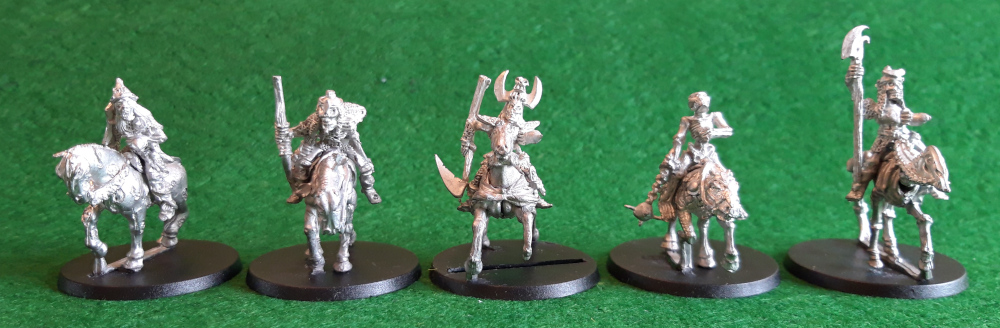
Today I was able to spend a little time prepping some very old (1985 according to the base tabs) Games Workshop mounted skeletons. This is a small force of five mounted skeleton warriors armed with an array of weapons on a varied set of undead horses.

Unfortunately, the ravages of time, and possibly some miscasting, had led to a few of the legs on the horses becoming damaged or to go missing. I glued and bent them into the best shapes possible and mounted them on 40mm round bases, one of which I managed to screw up, but I will fill the gap when it comes to basing the miniature. I will need to find the mounted skeletons some suitable shields too as the plastic ones that came with them are long lost; I will also need to remove a bit from the tabs on their arms that would have housed their original push-on shields. I will try to find some more of the same shields I used on the foot skeleton warriors.

I also dug out some old painted models that I had completed (iirc, the first two were originally painted by my friend Colin, but I have tidied them up a little to more match my own style) when I was on a roll back around the early 2010s. These will form a kind of command group for the skeleton warriors on foot, or maybe a variety of lich and/or undead lords/champions for Frostgrave or fantasy RPGs.

These will be added to the six Otherworld skeletons I have begun to paint over the last couple of days.

I am hoping to get a small undead force together from these and probably a small order from Otherworld to make up their numbers when I have some spare cash. Here's the undead band so far...

If I can get another half-a-dozen of the unarmoured variety of skeleton warrior and the six armoured versions of the same, that will give me a force of 3 command, 12 unarmoured, 6 armoured and 5 mounted skeletons. I can't imagine I will need more than a couple of dozen or so skeletons for the gaming I intend to run, but if I do, I will go down the plastic route, as it will work out a lot cheaper per miniature. There are several manufacturers out there from which I could build a significant force if I should want to put my mind to it.


What with the figures I have been painting for my son, and now these ones I am currently working on for myself, I will need to sort out some kind of storage. All of my old storage has been utilised by my Lord of the Rings figures, so I would need to buy another storage box or two for the latest figures I am painting. The Really Useful boxes that have been used to store the unpainted ones would not be conducive to keeping the paint jobs in tip-top condition, so foam lined boxes will be a necessity. I will look at these too when I am a little more flush.

Tuesday, 16 March 2021

Felt Battlemats

After the loss of so much of my scenery a few years back, I thought I would look at purchasing some stop-gap items to make the table look a little better for forthcoming games. After looking back at the last couple of battle reports, I thought that the first thing I needed to get was a battlemat.

With a battlemat as a purchase in mind I perused the websites of all the main suppliers of tailor-made solutions. There are some really lovely pieces out there, but they are well out of my price range as I am currently on a very limited budget.

So, I thought to look at haberdashery stores for my inspiration. For a mere £6.71 or so per item (plus £7.95 postage, which was actually very reasonable coming to the UK from Europe), I managed to find a German company online ( https://www.myfabrics.co.uk/felt.html ) that supplies 3mm thick felt that is 90mm wide but can be cut to size in 10mm measurements (minimum of 50mm). Thus, I was able to buy three 90mm x 90mm sheets of fairly sturdy felt that fit almost exactly onto my dining table (when not extended out). I decided to go for Dark Green, Grass Green and Slate Grey...

Forest and wildlands (Dark Green)...

This sheet will be used for battles in the wilderness; the dark forests of the Great Weald of Doggerland, the grasslands of Rohan and many others.

Cultivated and grasslands (Grass Green)...

This sheet will be used for battles in more cultivated areas; The Shire, parts of Gondor and more civilised areas on habitation.

Hills, mountains and cold wastelands (Slate Grey)...

This sheet will be used for battles in Frostgrave or hilly/mountainous regions.

All three are actually very nice colours in the flesh and work well for what I need them for.

I will hopefully be playing a game or two this coming weekend, so will let you know how well the different mats fare.

Monday, 8 February 2021

Skeletons and a Dragon

After the brief interlude of articles on dungeon aesthetics, I am slowly getting back to what I want to do with Frostgrave. I have begun digging through my unpainted backlog and came up with some fitting adversaries for Balthazar and his gang of ne'er-do-wells. As mentioned previously, I seem to have many more historical and human miniatures than I do monster stuff. I will see to remedying that by looking through the rulebooks to see what I have lying around that can be used and maybe look into purchasing some additional minis to bolster the numbers.

After the "mundane" (i.e. not supernatural) encounters on the way to Felstad have been overcome (more on Balthazar's adventures to come over the next few weeks), the first taste of the supernatural makes itself known as the frozen city gets closer. The overspill of magic from eons past causes more supernatural beings to spring into being and this will come as a shock to our intrepid party when they are first encountered.

I was able to dig out a couple of blisters of Otherworld Miniatures' Skeletons. I bought these many moons ago at a Salute show I went to and never got around to doing anything with them. I decided it was high time I got them out of the blisters, glued up and ready for some paint.

Here they are glued up as per the designs/images on the website. I may buy another few packs (they also do armoured skeletons) to make up the numbers (and provide more unique poses by swapping around the weapon and shield arms) as they are quite an easy adversary in Frostgrave (only 1 hit point each) and will come in handy for many other games.

I wasn't too enamoured by the shields that came with them, so they went into my bits box. The shields in themselves are OK, but the two different blisters contained different styles and I wanted them all to match as if they came from the same burial mound/crypt and/or era. So, I looked around in my bits box and found some alternatives from Conquest Games that fitted my vision better - plus I have more spares of the same, so if I do get more skeletons, then they can all be armed (shielded) in the same way.

I will try to get these undercoated in the next couple of days, but I will need to wait for a break in the weather if I want to use my usual spray can. I do have plenty of normal black paint, so I may just water that down a bit and brush it on.


This brings me onto the next bunch of miniatures that I sorted out; a few dragons and some trolls. The trolls are the three cave trolls and Burdhur, the hill troll chieftain that I have in my Lord of the Rings collection (I will do a separate post for these when I get around to painting them). I got out the greenstuff putty and filled the gaps around the joins between the arms and body, but I had some left over; what to do with it?

Luckily I had a couple of very old Ral Partha dragons (a blue dragon and some kind of Chinese style dragon - again, a later post will detail these) and a large plastic model from a magazine I bought the first issue of many years ago.


Now, I cannot remember what the magazine was called as I no longer have a copy of it, but I do recall that all the models that came with it were of differing scales, and that the dragon above was the only one worth collecting. I had peviously base coated it and stuck it onto a CD as a base, but where the undercoat spray missed, there was still a lot of the original colouring of the model showing through. I touched this up with watered down paint and used the remainder of the greenstuff to attach the wings more securely. This also allowed me to blend the wings to the body a little more (there were fairly large gaps).

I actually really like this miniature, so I will try to give it a good paint job whenever I get around to it. As to colour scheme, I am not entirely sure which way to go. The original colour was red, but I find that too cliched. Maybe I will go for some kind of green/brown mix, so it looks like it could be some long-lost antediluvian fire-breathing lizard with wings. Who knows? I will also take a fair bit of care and give the base a bit more attention than my usual sand, flock and tufts. Maybe I will have it guarding some treasure as well as its egg?

Hopefully next post I will have some of these at least partially painted.

Saturday, 23 January 2021

Dungeon Dwellers' Tactics

Actually, before we start, just a quick aside here - in the Labels section to the right of my main blog page I have listed DnD and D&D. In case anyone is interested, the former label is for older Dungeons and Dragons versions (AD&D, Basic, 3rd Edition and occasionally Pathfinder), and the latter is for 5th Edition onwards. Not sure why I differentiated them, but there you go, it probably meant something to me at the time. Sorry, back to the nuts and bolts of this post...

I didn't think that I would write another blog entry so soon on my old AD&D gaming days, but as I was writing the post on hirelings some of my old DMing moments kept coming back to me, so I made a note of them for future use. These thoughts all tended to be about dungeons and the monsters within them, so here is a post on just that as well as the tactics utilised by the denizens of those dungeons deep and caverns old.

I have always found large, rambling dungeon crawls to be a tad "unrealistic". As much as they are fun to play, in that you do not know what you will be encountering in the next room, they are also very brain in bucket style adventures. A few questions always used to pop into my mind when playing these types of scenarios; why don't the monsters next door ever peer round the doorway to ask the room inhabitants to pipe down when combat ensues as they are trying to get the kids off to bed? Why didn't the troll in room 3 not eat the goblins in room 4? How does a huge red dragon get into a room 50 feet underground with access by only 5 foot corridors? And so on.

So, to get around some of these anomolies I used to roll up mega dungeons in advance and part play them through in my minds eye prior to actual game play. I would check what was in each room and its adjacents to see how these beings would interact...

So, the aforementioned troll might allow the goblins scattered throughout the close by rooms to live because they can supply it with a constant stream of other food types. The troll would therefore become some kind of boss monster and I would rearrange the room contents accordingly. In other words the inhabitants could be worked into some kind of tribe/gang-type encounter.

That dragon may have been brought down as a youngling by a family of ogres as a plaything, but after a while it got too big to get out, so the ogres smashed out the roof to allow it to fly out in order to hunt.

These points then brought me onto local ecology issues. The dungeon obviously holds many small factions of hungry and dangerous beings. How would they eat, acquire weapons and armour and so forth? Why would they not just fight against each other until only one gang was left, or maybe two warring factions? This brought me to consider whether the goblins raided the local human farmers for their crops/livestock or did they trade with them? No point in killing the farmers if that meant the food source dried up in a couple of weeks is there? Better to keep them alive so supplies are available all year round would be my best interpretation. How would they pay for the food? Why, with adventurers' belongings hat have been killed in the dungeon seeking their own fortunes. Therefore, the dungeon ecology is directly linked to the local above ground economy.

Getting back to the tribe/gang point above, they would obviously set up some kind of hierarchy and certain troop types would be in certain rooms to aid in the defensive capabilities of the inhabitants. It would make sense to have the boss away from the edges of the mini kingdom so he can have a bit of peace and quiet and somewhere to store his treasure safely. The goblins would form the perimeter guards in a series of slightly tougher rooms as the boss troll is approached. These rooms might also be interspersed with the occasional one-off monster like a roper or mimic for a bit of fun, which leads me to my next couple of points...

Why do dungeon room occupants just charge pell-mell into combat at the first sight of a party of adventurers and not employ tactics?

Why don't they put together a reasoned out defence depending on who/what comes smashing through that dungeon door?

One of the first times I really thought this through was when I was running a small dungeon for a friend of mine to work his way through. In several rooms there were orcs, with the room inhabitants getting gradually tougher the deeper the player characters delved. Our usual style of play was along the lines of; characters listen at the door...they are told they can hear the guttural voices of orcs beyond the woodwork...the door is kicked down after PCs prepare spells etc... combat is joined with orcs just charging the party and getting wiped out in a few rounds.

This time round, things were different. The characters kick down the door and pour in. The orcs split with the larger brutes confronting the party in melee, the ranged weapon owners sniping from the rear and sides at the thieves and magic users, and the 1HP wonder running down the far corridor to warn their fellow guards. The party got the better of the brutes and ranged weapon orcs, but not without taking some damage, and headed to the corridor. At the end they could see a couple more orcs behind a make-shift barricade. The fighters duly charged the sorry sight, backed up by their lesser armoured compatriots. Combat was joined, but the party noted that there were a few more orcs behind the barricade to plug any gaps from their fallen brothers in arms. This didn't deter them until the large ballista showed up. They decided to about-face and run back down the corridor so as not to be hit by the powerful weapon, but stopped dead when they heard that the jeers from behind them were joined by roars of defiance ahead of them (the little 1HP scout had informed the orcs in the next few rooms what was occurring so their defence systems kicked into action). The party were trapped in the corridor and were cut to pieces - TPK.

Ordinarily, these three bands of orcs would have been pulled apart piecemeal by the party (we almost always played 6-8 PCs with several hirelings in tow, so a sizeable force) as they went room to room, but this time round, the orcs easily got the upper hand with a little thought. It also showed how powerful a 1HD monster actually is when used properly. They are as tough as most party members in a toe-to-toe fight.

This just goes to show that tactics can be employed for monsters to up the challenge ratings for the PCs. In future games I dialled back the number of critters in an encounter to take into account the tactical advantages that the residents of the dungeon would have. However, in addition to the tactics, I also included the noise factor - a combat will attract those in adjacent rooms to see what is going on or what advantage they can gain, as well as additional rolls on the wandering monster tables.

Dungeons are dangerous places and need to be prepared for every step of the way.

Thursday, 7 January 2021

Henchmen and Hirelings

This is the third, and possibly the last (for now) post on adventuring parties and their impacts on the local environment. This time I am going to discuss henchmen and hirelings. You will have to forgive me if I mis-remember the rules on henchmen etc. as I no longer have my 1st Edition AD&D manuals and it all comes from memory of playing as a kid.

In the previous posts, I mentioned that I used to hire men-at-arms and so on prior to mega-dungeon expeditions; mostly as treasure/supply bearers but also as additional cannon fodder. However, thinking back on what I wrote yesterday I seem to recall that there were four types of NPC character aides available to an AD&D character, namely Henchmen, Hirelings, Followers and Retainers. So, who and what are these types of underling?

Henchmen, followers and retainers, to my mind, are loyal to the character due to their force of character or esteem (usually based on the Charisma stat), but hirelings are only there for the money, and so may butt out when the going gets tough or the money runs out.

Henchmen - If I recall correctly, a character can hire a henchman X amount of levels lower than themselves at any time after the characters themselves attain a certain level depending upon the Charisma stat. They will be loyal and fight for the character even when the going gets tough. That said, they will not tolerate being abused too often, so a decent share of the treasure will always be welcomed. So, it is generally down to the player as to when the charcater should take one on, bearing in mind that there is also a limit to the numbers that can be hired. Where would these NPCs be found though? I cannot recall the exact rules, but I guess they would be encountered in cities etc. and will have tracked down the characters owing to their fame and good fortunes and ask to join the band in their service. Alternatively, this is my modern mind kicking in as I cannot remember if I did this or not, if an NPC is rescued or encountered on an adventure then there was a possibility she may join the list of those retained by that character.

Retainers and Followers - Upon reaching a certain level, fighters got castles, wizards got towers and other classes got whatever they aspired to according to their class; and it was filled with attendant NPCs. Again, these would be loyal followers at mostly '0' level but I recall that some could be higher level and act as sub-leaders (retainers?). Back in the day I always made sure my characters built their stronghold from their accrued treasure and, as a result, would spend hours poring over the DMG costing out all the relevant parts that made up the abode. I would then fill it with the correctly rolled amount of followers and organise them into patrols, units and so on. I saw these edifices as the place into which the retired character would return after their final adventure and begin to get involved in local politics. They would become future NPCs that hired new bands of heroes to do their bidding. But, where do their retainers come from? A dozen or so may be easy to pick up from the surrounding villages and towns but if a fighter needs 100+ men-at-arms then that would put a strain on any locale. In the past I just rolled the number and they were there. Nowadays, I would have to say that they arive in dribs and drabs until the final number is achieved in order to reduce the impact on the local populace.

Hirelings - These are the NPCs that are hired to carry out certain tasks on a short term basis: men-at-arms to fight alongside the PCs in dungeons, guard caravans or baggage trains whilst the PCs tackle the dungeon itself, or an apothecary to brew a potion, or a diviner to tell ones future and so on. When to hire these NPCs was determined by the skill sets that the party did not have, how much coin they had available and whether any were actually available for hire in that particular locale. Like with all people that can be hired, they are more fickle than the more loyal followers and henchmen; when the payments stop, so do they.

To hire a, ahem, hireling the cost is usually just a fee for their work or time; usually calculated by consulting the tables in the DMG and working it from there. The more loyal followers and henchmen will need to be looked after by the characters they are associated with otherwise dissention will breed (albeit no-where as quickly as with hirelings). This will be a more long-term cost as their upkeep will need to be met on a weekly, monthly or annual basis. Henchmen, as they take a share of the treasure, are easier to accommodate; no treasure equals no pay, but if there is a large hoard, then they will get their fair share. These, to me, are your typical hearthguard-type warriors as opposed to those called up for military service by a lord due to land ties - local fyrd-type warriors and thanes would come into this class as followers and retainers.

Adventurer retirement, as mentioned above, would be a time for the characters to rest on their laurels (unless the threat is huge) and become patrons for the new generation of heroes. If a new threat is exposed, they will no longer ride out to meet it themselves but will provide aid in the form of supplies and manpower (at a cost). This brings me to the final point of this post - what effect does this have on the local population and economy?

If a party breeze into a village, hire on all the local manpower and then proceed to lose them all in their latest dungeon escapade, the widows, orphans and old folk left behind will not be able to keep the village functioning when it comes to harvest or sowing time. The villagers would either starve, abandon their homes to go live with relatives, or start new lives anywhere their local lord would, or could, accommodate them. The lord would be furious as he would then be seriously out of pocket. Likewise, when a character gets to that certain level and acquires her retainers and followers, where do they come from? As mentioned above, the local city would be better as there are more numbers and a more diverse bunch of trades available. However, kitting out a castle with 100+ men-at-arms, or filling a cloister with dozens of clerics might draw suspicious looks from other local land holders or religious orders. Rivalries could build and spill over into violence and raiding.


So, where does this leave me with today's gaming? In the Frostgrave campaign I am currently prepping for, what are the people who follow Balthazar classed as? Dave, the apprentice, must be classed as a henchman; he is loyal and will be rewarded richly by the transfer of knowledge and some major treasure items. The initial band of soldiers that follow Balthazar will be classed as followers or retainers; they are paid out of the imaginary extraneous loot, but follow out of friendship (or coersion, but that is another story) and will die for their leader. However, if any of the said adventurers do die and have to be replaced, then their replacements must be hirelings, as they are brought into the fold with a one-off stipend. That said, and this is not covered in the rules from what I could see on my initial trawl through, what happens if they are not treated well? Could this be the place to write that loyalty table that is rolled upon after every adventure?

Wednesday, 6 January 2021

Dungeon Ecology

Hard on the heels of the Dungeon Parties post, comes this one about Dungeon Ecologies. This one was not intended to be as long as the previous one, as a lot of what was to be said in this one has been said in that one, but as with all things gaming I tend to ramble on forever and find new things to add as I am writing.

The previous article was more along the lines of what is an adventuring party. This one is more about the effects an adventuring party has on the local environs and the actual dungeon itself. To represent this post, I have trawled the net to find one of my favourite pictures from the original AD&D 1st edition Monster Manual (?) - an ankheg bursting from the ground to startle a farmer. This is kind of apt, as this colourised version of the artwork has the farmer looking very similarly dressed as one of the farmers from my Frostgrave party - I may use this as a Frostgrave scenario idea...

Like with all the images on my blog that are not my own copyright, please tell me to take it down if you are the owner and object to me using it without permission.

When I started to play AD&D again at my local club several years back, I wanted my campaign world to be believable (in as far as a fantasy setting can be). I still put most of the emphasis on playability but world coherency was also a significant part of my thought process. As mentioned in yesterday's post, "I built a little consistency and randomness into it too, to show that life was carrying on at that place even if the adventurers weren't around to see it happening".

When building the campaign world of Doggerland, I had to work out a back story for the region - accomplished by playing a few play-by-email games to build a solid timeline, then adding in a few historical characters and creating a point in time to then work from. I then added to the timeline and the current power-plays of the local area; who were the main pro/antagonists and what was likely to still be around in the environs even after the area had settled down after the last PBeM game completed. So I asked myself a few questions and worked out a few stats before putting pen to paper and making the scenarios fit the world...

Who built the dungeon and why? - Each scenario, whether hand-written or taken and adapted from a published magazine article or offical supplement, had to fit with what was going on in the main narrative. For example, at the start of the camapign, the weather in the Loidis region was in turmoil; hazardous weather limited travel, destroyed crops and basically hindered any progress for anything but the second coming of the demoness. I had a table written up linked to the phases of the moon and a random factor that stated what the weather would be like each day. Once the adventurers had solved the riddle and got the authorities in to destroy the power orb that controlled the weather, then normal patterns began to emerge again. This was a long-winded way to say that the broch in which the Cthonic druid resided had a history - it was an ancient, vitrified tower from the age of the first PBeM game and was tied to the history of the land. When the demoness was first encountered in Doggerland (I based this on details from the Temple of Elemental Evil history set out in that supplement) she was defeated, but her legacy lived on through her worshippers who still inhabited the abandoned places in the landscape awaiting her return.

Wandering Monsters had to fit in with what is in the dungeon - I made up small randomly rollable tables for encounters in and around the dungeon settings (based on the random encounter tables given in the supplements, or made up to only include monsters from the adventures I made up to keep them coherent. In other words, if a dungeon was full of, say, orcs, goblins and the like, then only those creatures plus a few standard trope wandering monsters (gelatinous cubes and the like) would be encountered there - no chance of a red dragon, for instance, as that would change the entire feel and objectives of the scenario. I also tried to fit the wandering monsters into the narrative of what was actually happening in the area around the dungeon. So, if a patrol of bandits was encountered and wiped out by the party then they had to have come from somewhere. If the scenario stated that some of the bandits at encounter location X put out patrols, then if I rolled bandits, they would be from that location and the results of the random encounter would mean that location explanation would be amended. A prime example of this was when the party had half-cleared the moathouse dungeon in the boglands near Staneford - the resident bad guy decided the heat was too much and he high-tailed it out of there with most of his followers before the party got to him.

Treasure and why monsters hoard it rather than spend it - Where do they get it from? Where do they spend it? These are questions that have always puzzled me, and to be honest I do not really have any hard and fast answers. In my campaign, the humans encountered would have earned it in some way. That said, most encounters with humans (unless boss types) resulted in poor treasure hauls; a small pouch with a few coins or the occasional magic item. Monsters, on the other hand, would be the ones that held onto magical trinkets and caskets of precious metals and gems. This doesn't really make sense to me, but as players want their characters to grow and become rich to enable them to do more in the imagined world they inhabit, I guess this strange treasure placement becomes part of the reward structure (along with gaining levels due to experience). I kind of explained this away by making it that these treasures were tribute from their lackeys, or items purloined from other adventurers who had tried to defeat them in the not so distant past. As to where the monsters could spend it, I have no idea, except maybe to pay their henchmen or bribe other bands of adventurers to let them go if they are on the point of defeat?

Re-populating a dungeon after a party has plundered it - This ruling really put my players off their stroke. After half-clearing an encounter location they would often return to civilisation to divvy-up treasure, re-equip themselves and heal in safety. Upon returning to the previous location they found that some of the rooms that they had cleared were now re-inhabited by new denizens - they were so used to playing in games where they literally just carried on from where they left off. I saw this re-population as the natural way in which societies and the natural world would re-align itself to a new situation; nature, as it is said, abhors a vacuum. If there is an ecological niche that becomes empty, then something will come along and fill it. Again, these rooms and caverns would be filled from either the nearest inhabitants expanding their demesne (possibly with new recruits) or by a wandering monster using the newly vacated area as a new home (and a new source of food in some cases).

Effects on the local human population when adventurers hit the town (or village) - This is also another item that is very rarely covered in the rulebooks. A band of adventurers rock up in a small village after plundering a dungeon, loaded down with coinage, gems, looted weaponry, and boastful stories. Where can they spend their ill-gotten gains? A small village would hardly be able to provide what the adventurers require - there is no Ye Olde Shoppe of Magicke like in the main cities (not that I use those in my camapigns anyway). So, they may be able to spend some treasure on finer lodgings, gambling and getting outrageously drunk on alcohol and satiated on fine food. However, villages can really only offer a brief respite from the harsh realities of the adventuring world and a means of re-stocking basic requirements; weapon and armour repairs, bows and arrows, lower class armours, food supplies, beasts of burden, maybe a riding horse or cart and local hirelings, as well as the usual R&R services.

Towns would only be a marginal step up but there would still not be enough on which the adventurers could spend their coins. So, what to do? There was one occasion during my last campaign that a fighter set up a fortification within the remains of the moat house in the fens. This cost a lot to do, so was a good way of spending his money, but it was a rare event albeit in keeping with 9th level fighters establishing a fortress according to the rulebooks.

Next step up are the cities; these allowed for at leaset one extra thing to be accomplished - training. Provided there was an NPC of the same class and a couple of levels higher than what the PC required, gold could be spent on a one-for-one swap for XP.

So, in reality, there is not a lot a band of adventurers can spend their gains on except a re-stock of arms and armour, rest and recuperation, maybe a bit of training, and having fun, with the local denizens trying to find ways of relieving the party of their cash and trinkets where they can.

But, the effect on the local economy can be catastrophic after the adventurers leave. All that excess gold and silver in the economy would artificially hike prices so that the local populace can no longer afford basic supplies and amenities. All the items that the party purchase would leave the town or village short of certain goods that may not be replaceable, and if there are any deaths due to hirelings being killed whilst away on an adventure, or in bar-room brawls then there will be a lot of widows and orphans. Who will look after them?


Again, this tended towards a longer than expected post, but, like all of my posts, they are written off the cuff and tend to ramble to wherever my thoughts take me. There is a kind of an idea in my head of what I want to cover but it never comes out how I envision it. I hope it makes sense and is coherent enough for you to get something from it.